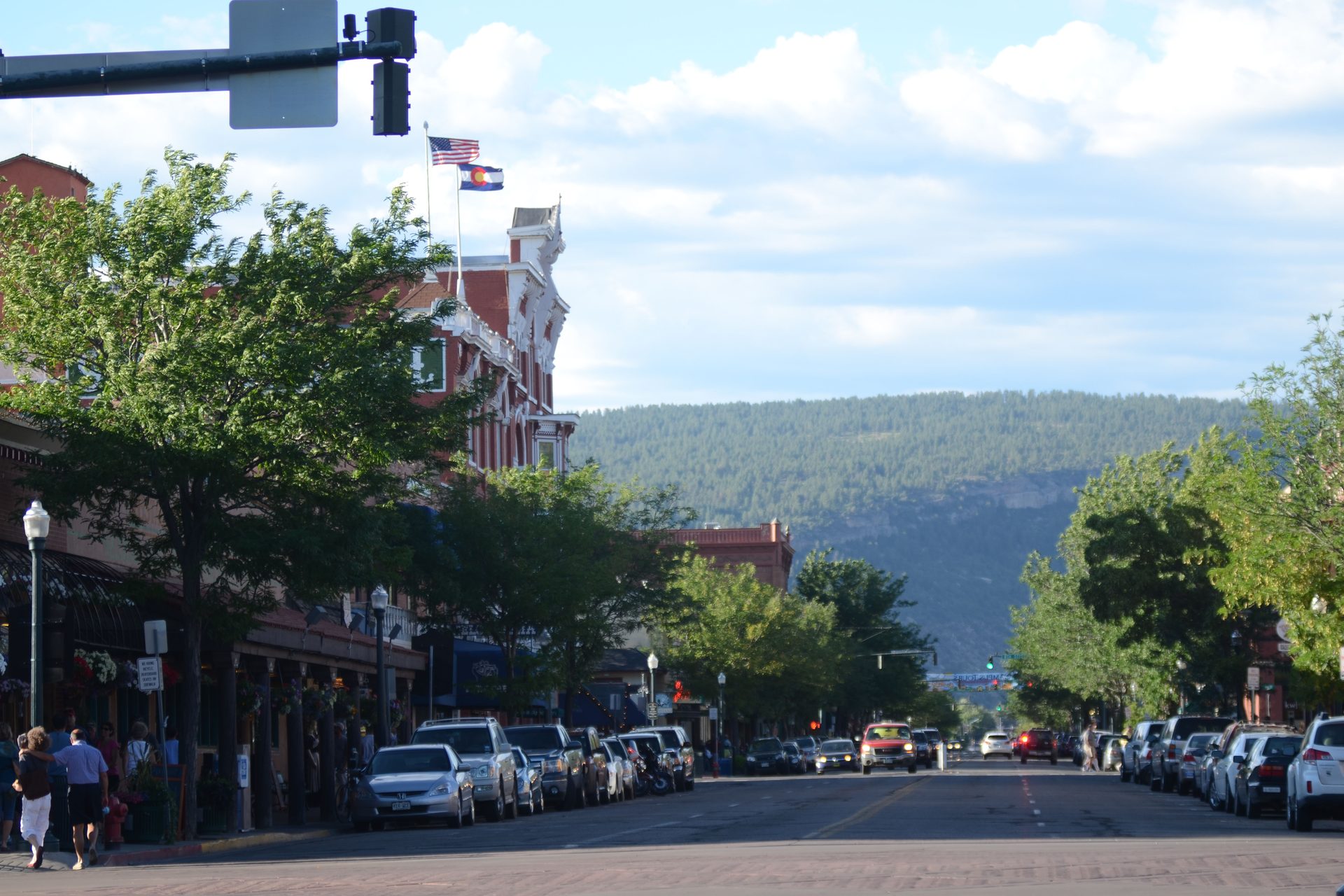
Downtown Durango is basically one long street. Main Avenue runs from the narrow gauge depot at the south end up through about a dozen blocks of Victorian brick, galleries, saloons and breakfast spots, and you can walk the whole thing in an hour and a half if you don't get distracted. You will get distracted. The street sits inside the Main Avenue Historic District, which went on the National Register of Historic Places on August 7, 1980.
Downtown Durango at a glance
| Fact | Detail |
|---|---|
| Founded | September 1880 by the Denver & Rio Grande Railroad |
| Historic district | Listed on the National Register on August 7, 1980 |
| Size | About 34 acres, 104 buildings in 1980 |
| Length of the walk | Depot to 11th Street, about a dozen blocks |
| Anchor landmarks | Narrow gauge depot, Strater Hotel, Newman Block |
| Free resource | Self-guided historic walking tour |
Why does Main Avenue look the way it does?
Because a railroad drew it. The Denver & Rio Grande Railroad founded Durango in 1880, after Animas City, two miles north, refused to cut a deal for a depot. General William Jackson Palmer, the railroad's president, and two partners formed the Durango Trust to sell lots, and civil engineer Charles Perin surveyed the grid that's still in use. Wholesale businesses went up by the tracks, which became Main Avenue, with the business district one street over on 2nd and homes on the hill. That's the downtown Durango account.
The buildings are mostly brick and stone for a reason. An 1880 newspaper item quoted by Western Mining History says four central blocks were reserved as a fire district where only brick and stone houses were permitted. Then, in 1889, a fire that started at a fruit and candy store at Main and 10th still burned seven blocks, including City Hall. The rebuilt street is the one you walk now. If you want the full story, our history of Durango goes deeper.
How big is the historic district?
The 1980 National Register nomination describes a 34-acre district. At listing it held 104 buildings, 86 of which contributed to the historic character, and its authors called it the core of commerce for the most important town in southwestern Colorado, according to the district's summary). Three historic districts exist in town in all, per the Advisory Council on Historic Preservation, but Main is the one visitors walk.
Where should you start?
Start at the depot, because the railroad is the reason any of this exists. The Durango & Silverton Narrow Gauge depot and its railroad museum anchor the south end of Main, and even if you aren't riding, loitering around the depot is one of the more authentic historic experiences in town. The train guide explains what's leaving and when.
Pick up the free self-guided historic walking tour at the Durango Welcome Center or download it from Downtown Durango. It maps the Victorian facades and old saloon sites. Prefer a person? Local operators such as Horsefly History Tours and Ghost Walk Durango run guided walks.
Walking Main Avenue block by block
Street numbers climb as you go north. These are the stretches worth slowing down for.
The 500s and 600s: hotels and sugar
The General Palmer Hotel at 567 Main wears the founder's name, and the block around it leans toward souvenirs and sugar: Christmas in Durango, Rocky Mountain Chocolate Factory. Up at 600, Balcony Bar & Grill has a patio hanging over the street, and Jean Pierre Bakery & Wine Bar at 601 settles the pastry question.
The 700s: the Strater
The Strater Hotel, at 699 Main, steals the block. Pharmacist Henry Strater built it in 1887, at the height of the boom, in red brick and white sandstone, and inside it's all handcrafted woodwork, hand-printed Victorian wallpaper and walnut antiques. Downtown Durango calls it a living history museum. The hotel's Diamond Belle Saloon was restored in 1957 where the Strater-Thorpe Drugstore used to be, and ragtime piano is part of the draw.
Grab something at Magpies Newsstand & Cafe or Grassburger when the antiques wear you out. This is also where Main gets busiest.
The 800s: galleries and the Newman Block
Art starts to dominate here. Sorrel Sky Gallery at 828 and Azul Gallery at 781 both sit on the strip, along with the Durango Antique Market at 780. The sandstone Newman Block, a three-story Richardsonian Romanesque building in the 800 block, held banks before it became the Kiva Theater in 1928, according to the Clio walking tour.
The Main Mall at 835 is the odd one out. The 1980 nomination describes it as a modern building designed to fit in, with about 35 businesses, built after a 1975 fire destroyed several older buildings. Eateries inside include Los Amigos del Sur and a gelato counter.
The 900s: banks, saloons and books
This block feels the most like the Old West. The Burns Bank (1892) sits at 900 and the First National Bank (1892) at 901, both named in the district's National Register nomination, with Durango Winery at 900 and Blue Rain Gallery at 934 nearby. El Moro Spirits & Tavern, at 945, was part of the old saloon district that thrived before Prohibition, according to Downtown Durango. A few doors up, Maria's Bookshop at 960 is a good place to pick up trail maps.
The 1000s and 1100s: beer and the north end
Carver Brewing Co, at 1022, is the long-running brewpub on the strip, and the brewery guide covers the rest of the taprooms. Keep going to 1101 and 11th Street Station crams a bar, food trucks and music into one block.
One more history stop sits nearby. According to Clio, the Central Hotel, completed in 1892, was the site of Jack Dempsey's 1915 knockout of Andy Malloy, and a restored mural of the bout is on the 10th Street side.
Where do you eat and drink on Main?
Almost everything you'll want is on the avenue or a block off it. For a full list, see the Durango restaurant guide. For a quick caffeine fix, the coffee shop guide has the downtown picks, and the nightlife guide picks up after dark.
How do you park downtown?
Easier than you'd guess. The city says meter enforcement runs Monday through Friday from 8 a.m. to 6 p.m., with no enforcement on weekends or holidays, and Downtown Durango adds that meters are free after 6 p.m. on weekdays and all day on weekends. Meters come in 30-minute, 3-hour and 10-hour versions. City lots are free after 5 p.m. and all weekend.
One catch: the city bars parking on the street in the Central Business District between 2 and 5 a.m., and cars can be towed. If you're staying overnight, use your hotel's lot or a municipal lot. The city parking page has the rules, and Downtown Durango's parking page lists current meter rates.
When is the best time to walk it?
Morning is quiet. Late afternoon has the best light on the brick, and evenings bring music and patios. On the first Friday of each month, galleries and shops stay open for the free First Friday art walk. If you'd rather skip the crowds, aim for spring or fall; the best time to visit Durango guide explains the seasons. And if you plan a longer stay, where to stay in Durango starts at the Strater and works outward.