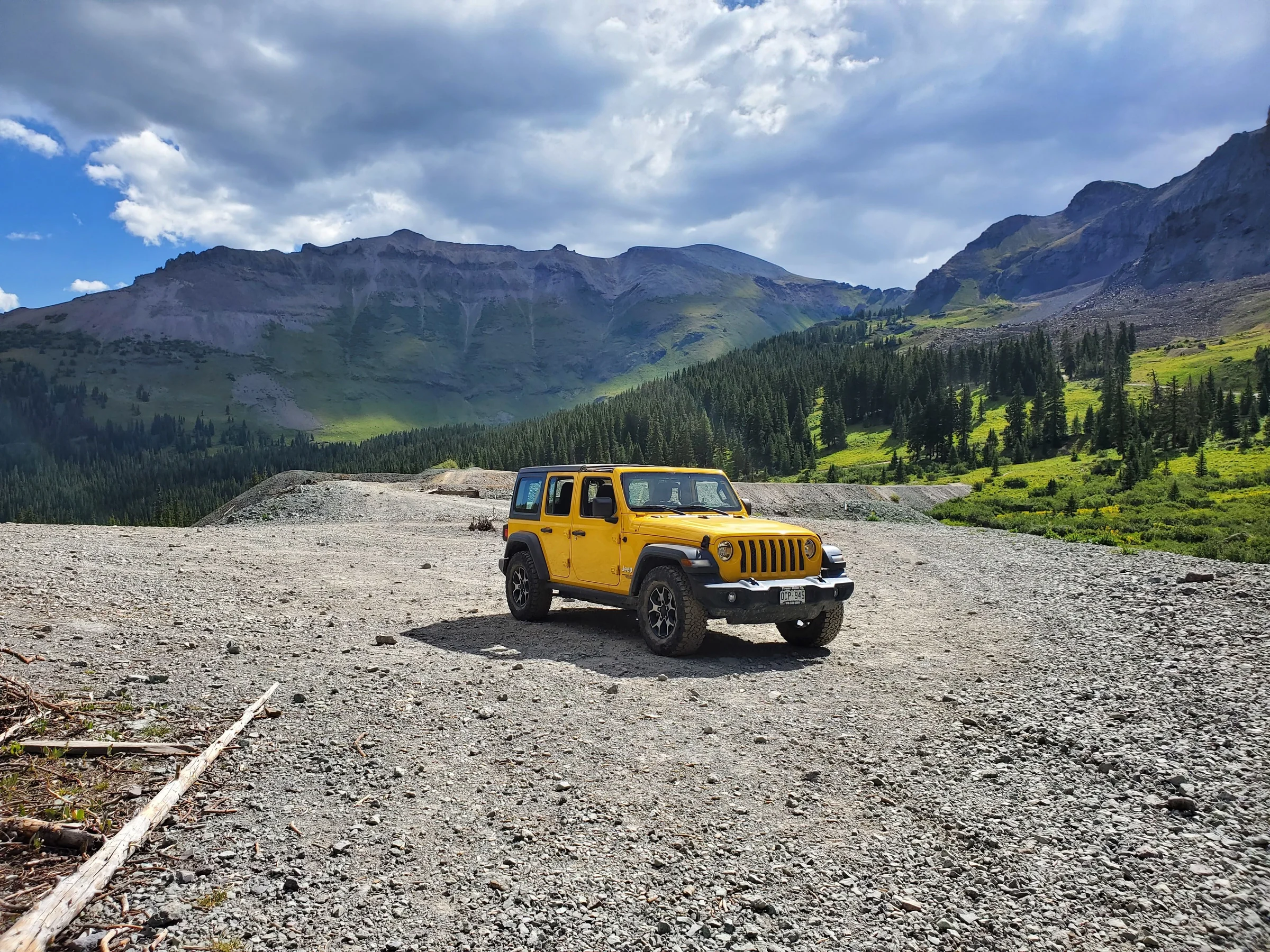
If you want to see the San Juan high country from behind the wheel, you have two real options: hire a guide and sit back, or rent a Jeep and drive it yourself. For most first-timers the guided half-day tour out of Silverton is the better call, and the rental makes sense once you have a day to burn and some confidence on loose rock. Here's how to choose, which roads are worth the effort, and what the season looks like.
Should you take a guided jeep tour or rent a Jeep?
Take the tour if this is your first time above treeline. Rent if you want a whole day of your own pace and you're comfortable on a shelf road with a drop on one side.
| Guided tour | Rental Jeep | |
|---|---|---|
| Who drives | A local guide | You |
| Typical length | Half day | Half day, full day or multi-day |
| Cost shape | Per seat; Mild to Wild lists its Silverton tour at $149, with a $129 youth rate | Per vehicle; outfitters we checked post roughly $230 to $330 a day for a four-door Jeep |
| Minimum age | 4 on the tours we checked | Driver must be 25 |
| You get | History, the good stops, someone else's problem if a tire goes | Freedom, plus a map and a suggested route |
| Best for | Families, first visits, anyone nervous about heights | Confident drivers, groups of up to five, repeat visitors |
Prices move, so treat those as a snapshot from October 2026 and check the outfitter's own page before you plan around them.
Where do the jeep tours actually go?
Two areas cover most of what you'll book.
Above Silverton on the Alpine Loop. This is the headliner. The Bureau of Land Management describes the Alpine Loop as a 65-mile system of unpaved roads linking Lake City, Silverton and Ouray, topping out around 12,800 feet, and notes it draws over 100,000 visitors a year. Half-day tours from Silverton usually head up toward Animas Forks, a mining camp at 11,200 feet that had about 450 residents by 1883. According to the BLM's Animas Forks page, a 23-day blizzard in 1884 buried the town under 25 feet of snow and residents dug tunnels between buildings. Walking into those cabins under a thin blue sky, you start to understand why they left every fall.
Out of Durango in the La Plata Mountains. Durango Rivertrippers runs a tour up La Plata Canyon toward Kennebec Pass, past the old town site of La Plata City, founded in 1875. The company says it reaches private mining claims, including a 25-foot waterfall. It's closer to town, so you give up less of your day to the drive. If you go the Silverton route, remember you're also committing to the paved climb on US-550 first, which our Million Dollar Highway guide walks through, and our Silverton guide covers the lunch stop.
Which roads can you drive yourself?
Plenty of people assume the Alpine Loop demands a lifted, winch-equipped monster. It doesn't, at least for the classics. What it demands is high clearance, four-wheel drive on the passes and a driver who stays calm next to a drop. That covers these three.
- Silverton to Animas Forks. The BLM's Animas Forks page lists it as 12.3 miles, rated moderate, best from May to October. It says the road is passable in summer by two-wheel drive, and the Lake City visitor guide agrees that most passenger cars can manage it if you take it slow. It's the easiest way to get a ghost town for the price of a dirt road.
- Engineer Pass (12,800 feet) and Cinnamon Pass (12,600 feet). Colorado DOT says both passes require a high-clearance four-wheel-drive vehicle. The full Alpine Loop runs 63 miles and takes 4 to 6 hours by CDOT's count. Lake City, which sits on the other end, tells first-timers to plan six to eight hours with stops. The side of Engineer above Animas Forks is the roughest part. Believe the people who say so.
- Ophir Pass (11,814 feet). The Forest Service calls it generally an easy four-wheel-drive road, but rates it moderate because of a narrow half-mile where two vehicles struggle to pass. Downhill traffic yields to uphill. It links the Million Dollar Highway north of Silverton to the town of Ophir.
Two warnings. Cell phones don't work in most of the Alpine Loop, according to the BLM, so download a map before you leave town and tell someone your plan. And the hard stuff, Black Bear Pass, Poughkeepsie Gulch and Governor Basin, is off the table for rentals at the outfitters we checked. Don't talk your way around that rule.
When is jeep season in the San Juans?
Short and weather-bound. Mild to Wild says its Silverton season runs May through early October depending on snowmelt, and Southwest Raft & Jeep says the 4x4 trails generally run mid-May through the end of October. The high passes come later. Lake City's guide says most open in late June and close after the first big fall storms, with the best wildflowers from mid-July into early August.
Pick your flavor. June brings snowbanks and loud waterfalls. July and August are for flowers and warm afternoons, though storms build over the peaks by early afternoon and you want to be off the passes by then. Late September turns the aspens and the tundra shrubs red and gold. For the wider seasonal picture, see the best time to visit Durango and the month-by-month weather guide.
What does renting a Jeep or UTV involve?
Paperwork, mostly. The rental outfitters we checked ask for a driver 25 or older, a US driver's license, a credit card and proof of full-coverage insurance, meaning comprehensive, collision and liability together. Your personal auto policy may not extend to a rental off pavement, so ask your agent before you show up. Several offer an optional tire and glass protection package, and tires are the part that actually suffers up there.
If you rent a UTV or side-by-side instead, Colorado Parks and Wildlife says every off-highway vehicle needs a registration or permit, and non-residents buy a permit, listed at $26.25 for the April-to-March year. Ask the shop whether it's already on the machine. Street-legal Jeeps need the permit too when they travel on designated OHV trails, per CPW, so ask about that as well rather than assuming.
Fuel up in town. There's no gas on the Alpine Loop.
How do you choose an outfitter?
Ask four questions, and any decent shop will answer all of them without a pause.
1. Which route, specifically? "Alpine Loop" covers a lot of dirt. You want to know if you're reaching Animas Forks, crossing a pass or skirting the edge of one. 2. What's the vehicle and who's in it? Open-air with a roll cage and blankets, like the ones Mild to Wild describes, is a very different day from a closed van. 3. What's the weather policy? Tours reroute for road conditions, and some need a minimum number of paid seats to run. Mild to Wild asks for four. 4. What fees sit on top? Mild to Wild adds 9 percent for river and land access fees, for instance. Fine, but know it going in.
Our site lists several local operators with Jeep trips or rentals. Mild to Wild Rafting & Jeep Tours and Durango Rivertrippers both run guided Silverton tours and rentals, and Southwest Raft and Jeep rents Wranglers. Others with listings include Flexible Flyers, Outlaw Rivers & Jeep Tours, 4 Corners Whitewater & Jeep Tours and Colorado Outback Adventures, which we profile in a separate post. Browse the full list under tours and outfitters.
What should you bring?
Layers, first. Passes run far colder than town, and Mild to Wild says even summer summits can call for a fleece and a beanie. Sturdy closed-toe shoes matter more than you'd think, because the ruins are uneven ground with old boards and metal scattered around. Add sunscreen, polarized sunglasses, a refillable water bottle and a camera.
Then there's the thin air. You'll spend hours above 11,000 feet, most of a mile higher than Durango, so drink plenty of water the day before, go easy on the beer the night before, and don't be surprised when a hundred-yard walk to a cabin leaves you winded.
Can you pair a jeep day with something else?
Easily. A common combination is the Durango & Silverton train up, a jeep tour in the afternoon, and the ride home on the rails. Outfitters sell it as a package. If you'd rather mix wheels and water, see our rafting guide, and for more ways to fill a free day browse the day trips from Durango. Hikers who want to stand on top of something rather than drive past it can look at climbing the 14ers near Durango.